The game · no money
The Chicken Road demo: what it is good for, and where the fakes are
A real Chicken Road demo runs the same board, the same four cards and the same ladders as the paid game. It is the cheapest way to learn where the multipliers actually sit. It is also the reason a lot of people misjudge their first real round, because the one thing it cannot simulate is the only thing that changes how anybody plays.
Searching for a Chicken Road demo turns up three kinds of page: the studio's own, a casino lobby running the real title in demo mode, and a long tail of sites that built something similar and put the name on it. The third kind is harmless if you know what it is and misleading if you do not, because a homemade clone can print whatever ladder its author chose.
Where a genuine demo runs
Two places, and only two.
The studio's own site. InOut Games publishes a demo of the title on its product page. This is the reference build — if anything anywhere disagrees with it, it is the other thing that is wrong.
A casino lobby in demo mode. Most operators carrying the game let you open it without depositing, and often without an account. This is the more useful of the two, because it also answers a question the studio's demo cannot: whether that particular lobby carries the game for you at all.
That second point is worth dwelling on. Game catalogues are cut by country and by licence, and a lobby page that loads is not proof the game will open — a search result and a working tile are different things. If you intend to play at a specific casino, opening its demo of this title is the only check that means anything. The casinos this site reads is where to start.
What the demo reproduces exactly
Everything about the board.
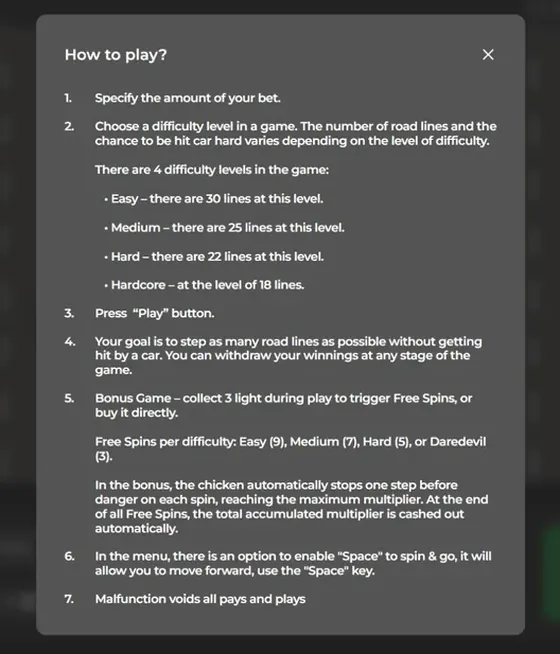
The four difficulty cards, with 30, 25, 22 and 18 lanes. The ladders: Easy opening 1.01, 1.02, 1.05, 1.09, 1.13, 1.18 and finishing 3.70, 4.22, 4.93; Medium opening 1.06, 1.20, 1.36, 1.54, 1.76, 2.03. The bonus counter above the road, three fires in Chicken Road 2 and three golden eggs in the first game. The free-spin counts of 9, 7, 5 and 3. The behaviour inside the bonus, where the chicken walks itself and stops one step short.
This is genuinely valuable. Reading that the Easy card ends at ×4.93 tells you a number; pressing thirty times to get there tells you what the card is actually like, and most people revise their plan after doing it once.
What it cannot show you, and why that matters
The stake is fake. That is not a small caveat — it is the only variable in the entire game that is under your control, and the demo removes it.
In demo mode there is no cost to pressing one more time, so almost everybody presses further than they would with money behind it. Then the first real round arrives, the same ladder is on screen, and the decision that felt obvious at lane 18 in the demo does not survive lane 9 with taka in the balance. People read that as the game “behaving differently”. It is not. The board is identical; the player changed.
Use the demo for what it does well: learning the shape of each ladder and where the interesting part of it sits. Do not use it to decide where you will cash out, because the demo cannot ask you the question that decision actually answers.
Spotting a build that is not the real one
Ignore logos and check the board against four facts, all of which are fixed:
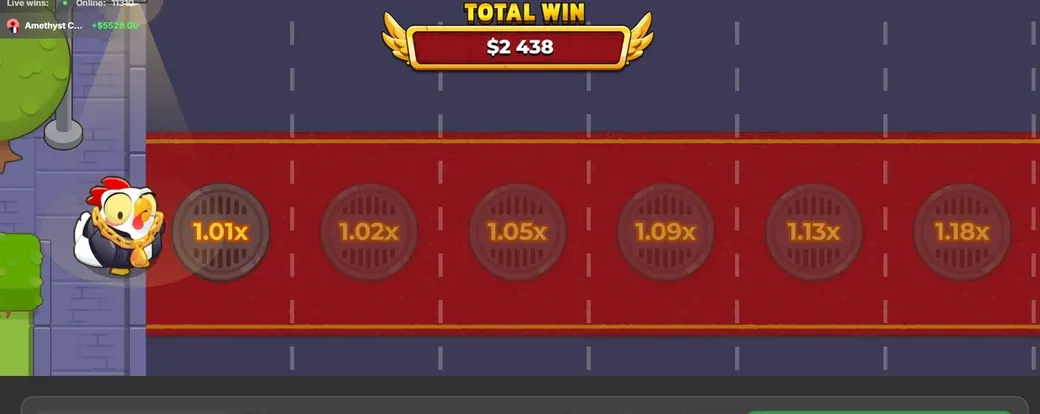
- Lane counts. 30 on Easy, 25 on Medium, 22 on Hard, 18 on Hardcore.
- The difficulty label. The row is labelled with a chance of being shot down in Chicken Road 2, or of collision in the first game. A build that prints no risk disclosure at all is not the studio's.
- The opening ladder. Easy starts 1.01, 1.02, 1.05. If the first lane pays 1.20, it is a different game.
- The fourth card's name. The rules text calls it Daredevil; the interface calls it Hardcore. A build that uses neither was written by someone who had not read either.
The same four checks work on a build handed over as a downloadable file, which is a separate question with its own page — what a Chicken Road APK actually is.
A clone is not necessarily trying to cheat anybody — most exist to collect search traffic. But a demo whose ladder was invented teaches you a ladder that does not exist, which is worse than not playing it.
After the demo
If the demo settled which card you play, the next question is which build to open, and that is a genuine decision with one clear answer per card. If it settled that you want to play for real, the expensive part is not the game, it is getting money there and back. And what the stake chips mean against a converted balance is the arithmetic the demo, by definition, hid from you.