The money · at the board
Stakes, chips and ceilings: the arithmetic a small balance runs into
The stake box is where a converted balance meets a game designed in round numbers, and the two do not line up neatly. The quick chips differ between the two builds, the bonus buy is priced at a flat hundred stakes, and the ceiling you are nominally playing for is unreachable at any stake a normal balance supports.
Everything on the board is priced in the casino's own unit, and a balance in this market got there by conversion. That gap is where the surprises live, and none of them are about the game being unfair.
The chips, and why the build matters more than it looks
Chicken Road 2 puts quick chips of 1, 2, 5 and 10 under the stake box, with a maximum of 200 a round. The first game offers 2, 3, 8 and 20.
Against a large balance that is a footnote. Against a balance converted from a few hundred taka it is the difference between a session and two rounds — the smallest chip in the older build is double the smallest in the newer one, and the step up from there is to 3 rather than to 2.
This is the practical reason a small balance belongs in Chicken Road 2, and it is a stronger reason than the ceilings. The build comparison covers the case where the older title is still the better choice, which is the Medium card and its ×14,000.
What thirty presses are worth
The Easy card runs 30 lanes and finishes at ×4.93. Get all the way to the end of it — thirty clean presses, no car — and a stake of 1 returns 4.93.
Hold that number against the chain the money travelled through. Two conversions with two spreads and two fees, in and out, on a deposit small enough that fixed fees are a visible share of it. A perfect Easy round on the smallest chip can arrive back in a mobile wallet worth conspicuously less than the screen suggested.
None of that is the casino shaving anything. It is what happens when a small amount crosses several systems, and it is an argument for two specific things: deposit in one deliberate amount rather than several small ones, and do not play the longest, flattest card with the smallest chip unless the pressing itself is the point. The route the money takes sets out the steps and their costs.
The bonus buy against a real balance
The buy price is flat: exactly 100 stakes, always.
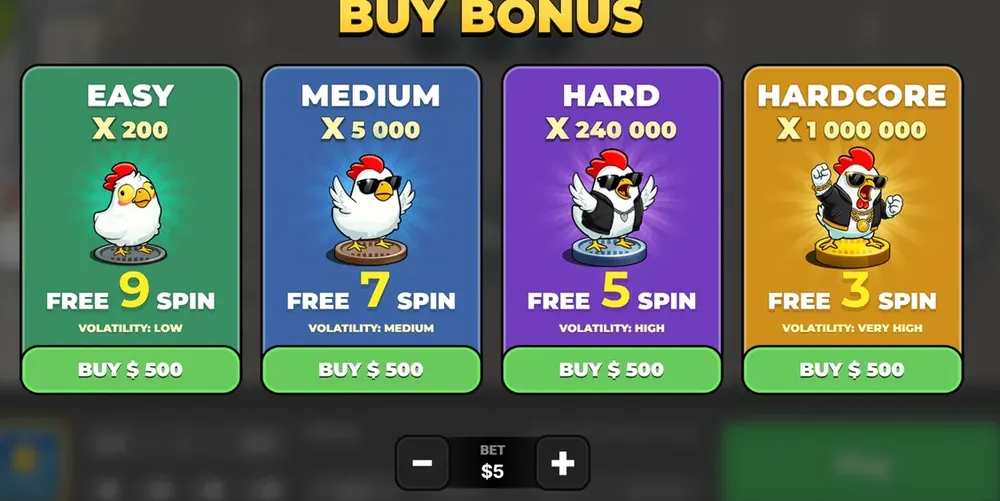
| Stake | Buy costs |
|---|---|
| 5 | 500 |
| 10 | 1,000 |
| 20 | 2,000 |
| 200 | 20,000 |
Which means the bonus buy is not an option for most balances in this market — a hundred stakes is a hundred rounds you could have played instead, spent at once, on a feature that settles itself with no decision to make.
Four purchases recorded at the board, one per card, came back at 1.22, 0.93, 0.57 and 0.18 times the price on Easy, Medium, Hard and Hardcore. Four results predict nothing about a fifth. The spread between them is the point: this is a high-variance purchase, and buying it with a balance that cannot absorb a 0.18 is the fastest way to end a session.
Ceilings you are not actually playing for
The published ceilings are ×200 on Easy, ×5,000 on Medium in Chicken Road 2 and ×14,000 in the first game, ×240,000 on Hard and ×1,000,000 on Hardcore.

A maximum multiplier of ×1,000,000 implies a frequency of roughly one round in a million — that is arithmetic on the multiplier, not a figure anyone has published, and it is marked as a calculation here rather than presented as a fact. It also assumes eighteen consecutive clean presses on the card with the shortest ladder and the highest risk per step.
The ceilings are real and they are printed on the card. They are not a plan.
The limit that will actually matter to you
Not the ceiling. The withdrawal cap.
Among the operators this site reads, the published caps run from 5,000 USD a month to 15,000 EUR a month to 1,000,000 USDT a week, each under a numbered clause in the operator's own terms. The first of those is reachable from one good round on a Hard card, and a player who has never read it finds out about it at the worst possible moment.
The same goes for verification. Some operators publish a threshold amount; others use a risk-based clause with no stated trigger. Both are printed per operator in the table, and the difference decides whether you can plan a withdrawal or only hope for one.
A sensible way to size a session
Pick the total you are willing to lose before opening the cashier, convert it once, and split it into a number of rounds you can count. Then pick the card that matches that number: if the balance supports twenty rounds, the 30-lane Easy card is not the card — its value is concentrated in lanes you will not reach often enough for it to pay for the pressing.
One thing the stake box does not change is where you open the game: the browser version and anything offered as an app or an APK run the same board at the same chips.
Set the deposit limit in the account settings at the same time. Every operator here has them, and a limit set while calm is a different object from a limit promised at lane 14.
If the point is only to see how the ladders behave before any of this, the demo does it for nothing.